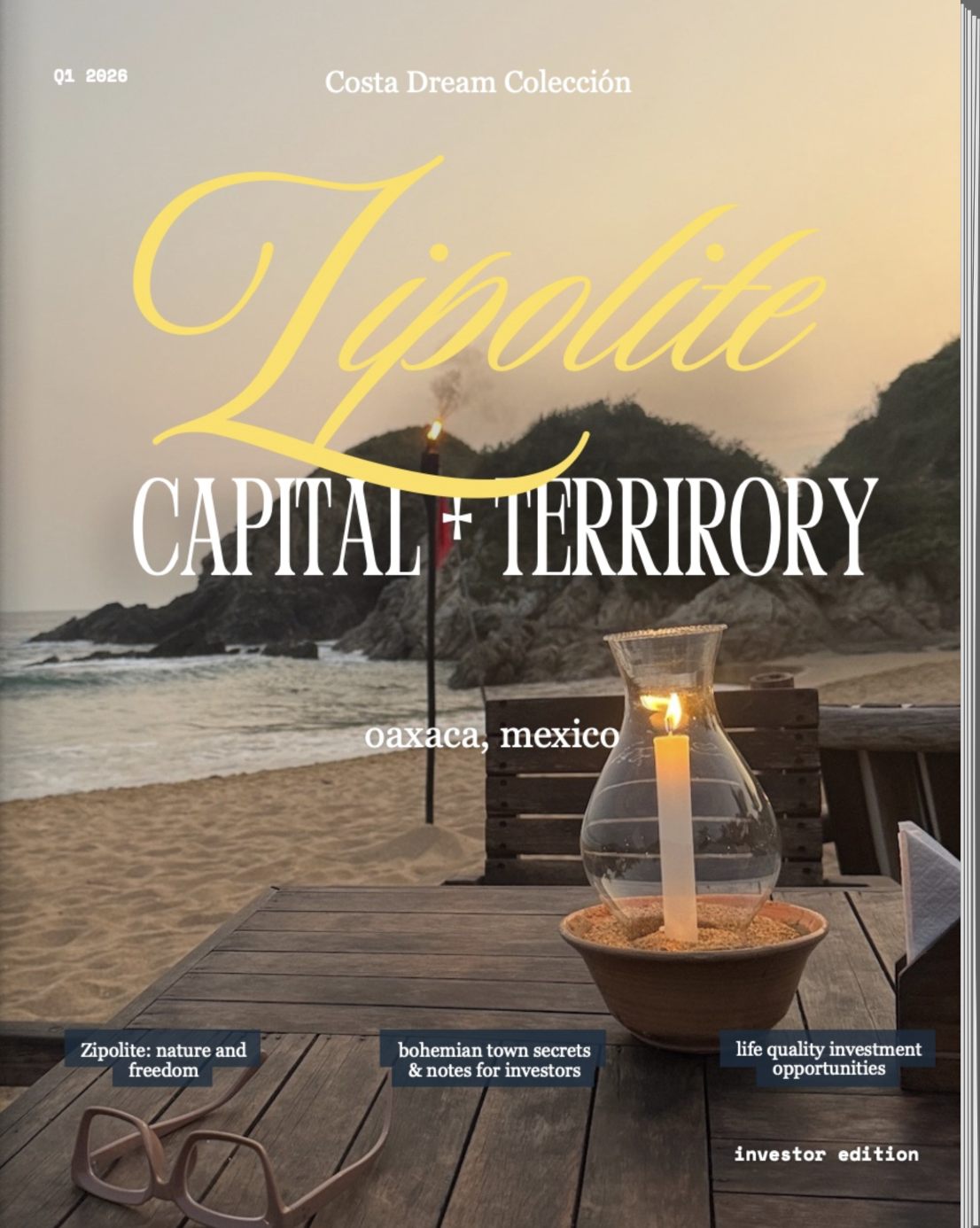
Zipolite’s final version below includes the LGBT / New York buyer angle, in the same institutional, positive tone and parallel structure to your Puerto Ángel piece.
A Density‑Driven Coastal Play: Institutional‑Grade Investment Logic for Zipolite, Oaxaca
Zipolite, Oaxaca, has transitioned from a countercultural beach enclave into one of Mexico’s most distinctive niche coastal markets, combining high‑intensity tourism demand with an increasingly sophisticated boutique‑hospitality and residential offer. Within Mexico’s broader tourism expansion and coastal real‑estate re‑rating, Zipolite functions as a compact, walkable, lifestyle‑driven node where demand is already visible in occupancy, ADRs, and an emerging pipeline of ocean‑view residential and hospitality assets. As with Puerto Ángel, village‑level official statistics remain limited, so this briefing relies on national and state‑level institutional data, complemented by credible tourism, media, and market‑platform sources, with explicit caveats where Zipolite‑specific figures are not available.
Macro context: Regional tourism and investment positioning
At the national level, Mexico’s tourism sector continues to represent a material share of GDP and employment, with inbound tourism recovering and expanding after the pandemic according to OECD‑type analyses and national tourism reporting. Oaxaca’s coastal corridor between Puerto Escondido and Bahías de Huatulco is consistently highlighted in tourism‑promotion and investment narratives as a strategic zone for higher‑value visitors and boutique hospitality formats. Zipolite is embedded in this corridor and formally sits within the broader Ventanilla–Puerto Ángel area in state statistics, but in functional terms operates as a distinct, branded micro‑destination with its own demand base and identity.
International travel media and LGBTQ+ outlets describe Zipolite as “Mexico’s best‑kept queer secret” and a rising LGBT+ coastal haven, signaling a differentiated, experience‑driven segment of demand rather than anonymous mass tourism. This qualitative positioning is reinforced by national‑level features that frame Zipolite as an “oasis for the queer community” and a symbol of inclusive tourism on Mexico’s Pacific coast, drawing attention from global urban centers.
Investment drivers: Tourism, identity, and connectivity
State‑level planning documents emphasize connectivity and airport capacity as key levers for coastal‑tourism growth, and Zipolite benefits indirectly from the combined catchment of Puerto Escondido and Huatulco airports, each of which maintains solid seat‑load factors and growing route networks. From these gateways, Zipolite is accessible via roughly one‑hour to ninety‑minute overland transfers, placing it within a feasible access band for North American and European travelers, including medium‑stay and repeat visitors.
Zipolite’s primary demand driver, however, is not infrastructure scale but cultural identity. It is officially recognized as one of Mexico’s few clothing‑optional beaches and is widely cited as an LGBT+ friendly space, with Playa del Amor frequently referenced as Mexico’s only “official” nude beach. International coverage highlights the town’s appeal to queer travelers seeking an alternative to hyper‑commercialized hubs like Puerto Vallarta, underscoring a structural niche in the global tourism map rather than a generic sun‑and‑beach commodity destination.
Local market dynamics: Prices, occupancy, and asset classes
Granular, village‑level real‑estate transaction data for Zipolite are not published by official Mexican statistical agencies, but commercial listing platforms and specialized coastal brokerages provide a workable proxy. Ocean‑view condos, hillside residences, and boutique‑scale hospitality assets in Zipolite are marketed across a wide price band—from roughly the low‑to‑mid 200,000 USD range for compact ocean‑view units to 400,000–600,000 USD and above for larger villas and beachfront penthouses—indicating a layered market that can accommodate both upper‑middle‑income buyers and more capitalized investors. As in Puerto Ángel, these are asking values rather than realized price series, and no long‑term official appreciation curve for Zipolite alone is available.
On the operational side, Zipolite’s short‑term rental and boutique‑hotel segments exhibit robust performance indicators. Travel and LGBT‑focused tourism media consistently reference near‑full hotel occupancy and high ADRs during peak season, with particular emphasis on December–March and festival periods such as Nudist Week and Zipolite Diverso. The hospitality landscape is dominated by small, design‑forward boutique hotels, clothing‑optional guesthouses, and LGBTQ‑owned or LGBTQ‑inclusive properties, many of which cluster along the beachfront and adjacent hillsides. This asset mix supports a dense but human‑scaled tourism environment, where operational excellence and concept differentiation directly influence yield.
Investor segmentation: Lifestyle, LGBT, and New York–linked demand
Zipolite’s investor base is shaped by its identity as a queer‑friendly, countercultural coastal town. International journalism and LGBTQ travel media describe an influx of gay and queer visitors from major North American and European cities who progressively transition from repeat tourists to medium‑stay residents and, in some cases, property owners. Reporting notes that a significant share of these visitors come from large US urban centers, including New York, Los Angeles, and other East Coast cities, which function as feeder markets for both tourism and lifestyle‑driven investment.
While no official registry disaggregates buyers by city of origin, local observation and LGBTQ‑focused real‑estate platforms indicate growing interest from New York–based couples and professionals who are converting recurrent stays into ownership of ocean‑view condos, villas, and boutique hospitality projects. In practical terms, this translates into three dominant investor clusters: lifestyle buyers anchoring part‑time or full‑time residence in an inclusive coastal environment; boutique‑hotel operators and hybrid owner‑operators leveraging peak‑season ADRs and occupancy; and remote workers or “slow‑living” migrants from cities like New York who are reallocating lifestyle and housing budgets into Zipolite assets as a hedge against high big‑city housing costs.
Structural risks: Gentrification, infrastructure, regulation, and environment
As in many emerging coastal markets, Zipolite’s strengths bring familiar structural risks. National and regional media already flag gentrification pressures, noting that the inflow of higher‑income domestic and foreign visitors, including LGBT travelers and new residents, has begun to push up rents and property values, raising concerns for long‑term local affordability. This mirrors broader patterns in Mexican coastal tourism zones, where small villages transitioning into lifestyle destinations must balance investment inflows with social and cultural cohesion.
Infrastructure and environmental constraints also remain relevant. Zipolite’s dense, low‑rise coastal strip and hillside settlements depend on regional water, waste, and energy systems that, according to state‑level commentary on coastal Oaxaca, operate under increasing stress as tourism and residential demand rise. Like other Pacific coastal communities, Zipolite is exposed to coastal‑erosion, storm‑surge, and sea‑level‑rise risks, although detailed, village‑scale hazard mapping is not systematically published. On the regulatory front, investors must navigate Mexico’s broader challenges around mortgage penetration, informal building practices, and varying degrees of zoning enforcement in secondary markets, which can affect title clarity and permitting for new developments.
Non‑obvious insight: A high‑identity, differentiation‑driven play
The non‑obvious, data‑grounded opportunity in Zipolite is that it operates as a high‑identity, differentiation‑driven market, where upside is less about discovering an overlooked village and more about aligning capital with the town’s deeply rooted cultural and community positioning. International coverage as an LGBT+ “oasis” and queer‑friendly nude beach, combined with visible interest from New York and other global‑city residents, signals a durable niche demand segment that is less price‑sensitive and more experience‑driven than mainstream coastal tourism. This creates room for boutique hospitality and residential projects that integrate design, inclusivity, and wellness into their core value proposition, rather than relying solely on macro appreciation or volume‑based rental strategies.
For institutional‑grade and sophisticated individual investors, Zipolite’s logic is therefore to treat the village as a stabilizing lifestyle anchor with yield potential, not a speculative flip. The combination of finite buildable coastline, a growing base of LGBT and New York‑linked buyers, strong seasonal occupancy, and a still‑present value gap versus Mexico’s most saturated beach hubs supports a thesis of disciplined, medium‑ to long‑term capital deployment into well‑designed, community‑aligned assets. In this frame, Zipolite’s dense, identity‑rich ecosystem becomes a structural advantage: investors who respect and amplify that ecosystem can capture durable cash flows and capital growth in a market where lifestyle and long‑term value are unusually tightly coupled.
------
Prepared by Costa Dream Realty, a real estate advisory and investment intelligence firm specializing in data-driven analysis of emerging property markets and lifestyle investment destinations.
Costa Dream Realty is a data-driven real estate agency focused on coastal Mexico investment markets, helping international buyers understand where lifestyle and long-term value intersect.
Our work is based on verified data from government sources, international organizations, and academic research. We focus on measurable indicators such as tourism growth, infrastructure development, rental demand, occupancy trends, and property value dynamics. We analyze coastal regions like Oaxaca through an investment lens, identifying how shifts in tourism, remote work, and boutique hospitality are shaping real estate demand.
Rather than relying on marketing narratives, we prioritize clear market fundamentals and real economic signals. The goal is to help investors make informed decisions in emerging coastal markets where information is often fragmented or unclear.